
If you have been hearing “Agentforce” everywhere in Salesforce conversations but are not sure what it actually means for your marketing team, you are not alone.
Agentforce is one of the most significant product shifts Salesforce has made in years. It is not simply an update to an existing feature. It introduces a new layer of AI capability that changes how marketing platforms can operate and it is already embedded in Salesforce’s current marketing products.
This article explains what Agentforce is, what it can do for marketers today, and what you need in place before it can deliver meaningful value.
What Is Salesforce Agentforce?
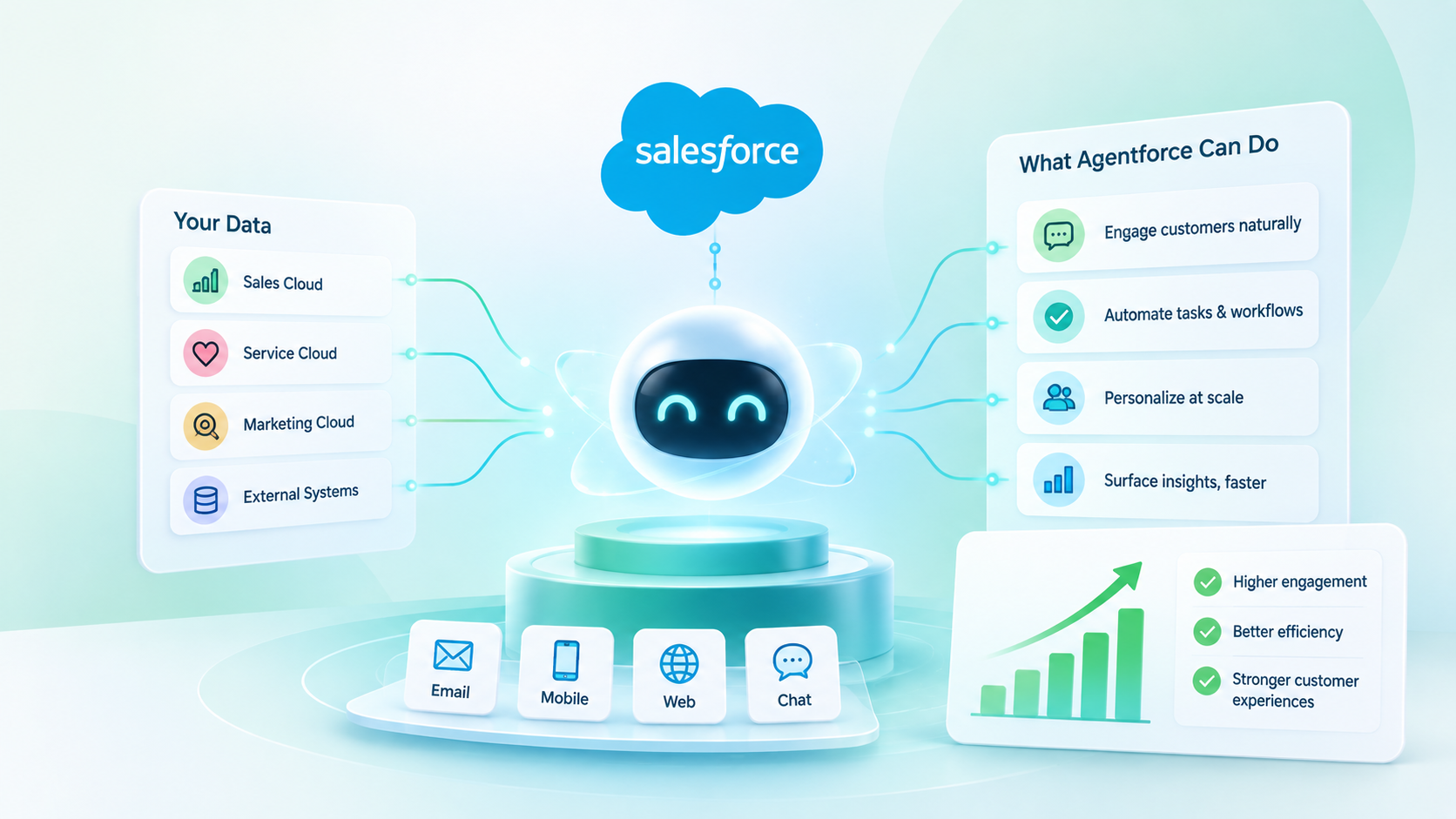
Agentforce is Salesforce’s autonomous AI agent platform. Unlike traditional AI that primarily predicts, recommends, or generates content, Agentforce agents can take action.
That distinction is important.
While Einstein might recommend the best time to send an email or identify highly engaged contacts, Agentforce can take the next step. Based on a natural-language instruction, an agent can build a campaign, create an audience segment, draft email or SMS content, trigger a journey, and monitor performance.
With Agentforce Campaign Creation, marketers can build and deploy campaigns in hours rather than weeks. Teams can collaborate with Agentforce to create a campaign brief, then allow AI agents to build the audience, draft the content, and set up the customer journey.
The broader shift is from AI as a supporting tool to AI as an operating layer:
- Supporting role: AI surfaces an insight, and a marketer decides what to do.
- Operating role: A marketer defines the goal, and the AI agent carries out the work.
Unlike platforms that simply add AI capabilities to existing systems, Marketing Cloud Next was designed around agentic marketing, with AI agents capable of handling complex marketing tasks.
Important naming context: Salesforce now presents its marketing lineup under the name Agentforce Marketing, with Marketing Cloud Next as the flagship product. The classic platform is called Marketing Cloud Engagement. The “Marketing Cloud” name is still widely used, so you may hear all three terms in practice.
What Is Agentic AI? How It Differs from Einstein
Einstein is Salesforce’s predictive AI suite. It analyses historical data and makes recommendations, such as the best time to send a message, which contacts are most engaged, or which subject-line patterns are likely to perform well.
A human still needs to act on those recommendations.
Agentforce works differently.
Agentforce for Marketing Cloud is an application of Salesforce’s broader Agentforce platform. It uses configurable AI agents that can act autonomously, access CRM and Data Cloud context, and execute workflows through Flows, APIs, and Marketing Cloud tooling.
| Einstein | Agentforce | |
|---|---|---|
| Type | Predictive AI | Agentic AI |
| What it does | Recommends and scores | Takes action autonomously |
| Human role | Acts on the output | Defines the goal; agent executes |
| Marketing use | Send Time Optimisation, Engagement Scoring, Copy Insights | Campaign creation, audience building, journey execution |
| Data dependency | Send history and engagement data | Unified customer profiles in Data Cloud |
The two technologies are not replacing one another.
Einstein continues to power capabilities such as send time optimisation, engagement scoring, and copy insights. Agentforce adds the ability to act on those insights and execute marketing tasks without requiring a human to manually trigger every step.
What Agentforce Can Do for Marketers Right Now
Campaign Creation
Campaigns can now be assembled and optimised in Marketing Cloud Next.
Marketers can deploy campaigns in hours rather than weeks, with capabilities for always-on execution, performance monitoring, and real-time optimisation based on defined goals and guidelines.
Audience Segmentation Without SQL
Agentforce can help marketers create target audience segments in minutes.
Instead of manually building complex segmentation logic, marketers can describe the audience they want to reach in natural language. The agent can translate that instruction into specific segment attributes across unified customer data.
No SQL required.
Two-Way Customer Engagement
With Agentforce embedded across email, SMS, and web, traditional “do-not-reply” communications can become two-way customer conversations.
This also creates a closer connection between marketing and other Salesforce functions, including sales, service, and commerce.
Performance Analysis
Marketers can ask questions about campaign and audience performance and surface insights across unified data.
The goal is to reduce the gap between insight and action, allowing teams to understand what is happening and make decisions without leaving their existing workflow.
Paid Media Optimisation
Agentforce Paid Media Optimisation can automatically monitor and optimise cross-channel campaigns around the clock, reducing the amount of manual effort required from marketing teams.
What Agentforce Cannot Do
Agentforce is powerful, but it is not a replacement for marketing strategy.
It Cannot Replace Marketing Strategy
Agentforce executes instructions. It does not define the overall marketing strategy, establish the brand voice, or decide what a campaign should ultimately achieve.
The marketer still defines the goal. Agentforce handles the execution.
For example, “improve our marketing” is not a useful brief for an AI agent.
A more actionable instruction would be:
“Build a re-engagement campaign for customers who purchased in Q4 but have not purchased since.”
The clearer the objective and constraints, the more useful the agent’s output is likely to be.
It Cannot Work Effectively Without Clean, Unified Data
Data Cloud is the connective tissue that brings together customer signals from CRM, web, commerce, and third-party sources.
This gives Agentforce agents access to customer profiles and event data they can use when making decisions and executing tasks.
If your data is fragmented, incomplete, or not flowing into Data Cloud, Agentforce will have limited context. Even a well-written prompt cannot compensate for poor underlying data.
It Does Not Operate in Every Salesforce Marketing Cloud Account
Agentforce is available through Marketing Cloud Next, including Growth and Advanced Editions, as well as Account Engagement+ offerings.
All Marketing Cloud Account Engagement customers can now access Agentforce Campaign Creation.
However, teams using classic Marketing Cloud Engagement without an upgrade path will have limited or no access to the newer Agentforce capabilities.
Where Agentforce Fits in the Salesforce Marketing Ecosystem
Agentforce combines generative AI and LLM capabilities with real-time customer signals from Data Cloud. The goal is to give AI agents enough context to make decisions and execute actions within Salesforce’s marketing ecosystem.
In practical terms, Agentforce sits across three key layers:
- Data Cloud (Data 360): The unified customer data layer that Agentforce reads from and acts on.
- Marketing Cloud Next: The marketing execution platform for journeys, email, SMS, and audiences.
- Salesforce CRM: The source of account, contact, and opportunity data that Agentforce can reference.
Data Cloud is particularly important.
Without unified customer data, Agentforce’s ability to personalise experiences and create meaningful segments is significantly limited. Organisations evaluating Agentforce should therefore assess their Data Cloud readiness alongside their Marketing Cloud setup.
What You Need in Place Before Agentforce Adds Value
Agentforce is not plug-and-play for most organisations. Several foundations need to be in place first.
1. Unified Data in Data Cloud
Fragmented data produces fragmented AI output.
The quality of Agentforce’s work depends directly on the quality, completeness, and accessibility of the customer data available to it.
2. Clearly Defined Use Cases
AI agents need clear instructions.
“Improve our marketing” is too broad to produce a reliable outcome.
A specific use case, such as building a re-engagement campaign for customers who purchased in Q4 but have not purchased since, gives the agent a defined objective and audience.
3. Governance and Review Processes
Agentforce can act autonomously, but that does not mean every action should happen without oversight.
A human review layer remains important, particularly for areas such as email content, audience selection, and campaign deployment.
4. Appropriate Licensing
Before designing workflows around Agentforce, confirm which capabilities are included in your current Salesforce agreement.
Licensing and product availability should be part of the implementation assessment—not something addressed after the workflow has already been designed.
Is Agentforce Right for Your Organisation Right Now?
Marketing teams in 2026 are under pressure to do more with less, while expectations for personalisation, campaign speed, and measurable ROI continue to increase.
Agentforce is designed to address these demands within the Salesforce marketing ecosystem.
But it is not the right starting point for every organisation.
Good Fit for Agentforce Now
Agentforce may be a good fit if:
- You are using Marketing Cloud Next Growth or Advanced, or Salesforce Account Engagement.
- You have Data Cloud in place with a reasonably complete customer profile.
- Your team can define clear campaign briefs and review AI-generated output before deployment.
- You have specific, repeatable campaign processes that an AI agent could handle reliably.
Better to Wait
It may make more sense to focus on the foundation first if:
- You are using classic Marketing Cloud Engagement with no near-term upgrade plan.
- Your customer data remains fragmented across multiple systems and is not yet unified in Data Cloud.
- Your team does not yet have a process for reviewing and governing AI-generated content and audiences.
The honest answer for many marketing teams is that the foundation needs to be in place before the AI can deliver meaningful value.
Agentforce is not a shortcut around data strategy or platform readiness.
Going Deeper
If you are exploring AI and Salesforce Marketing Cloud, these related topics may also be useful:
- What AI Can and Can’t Do in Salesforce Marketing Cloud
- ChatGPT vs Salesforce Einstein: What Marketers Need to Know
- Salesforce Einstein AI: Every Feature in SFMC Explained
- How to Design a Data Model in Salesforce Marketing Cloud
Want to understand how Agentforce fits into your current SFMC setup and what steps would get you ready? Talk to our team.
Glossary
Agentic AI: A category of AI that can take autonomous action to complete a goal, rather than only making recommendations that require a human to act. Agentforce is Salesforce’s agentic AI platform.
Agentforce: Salesforce’s autonomous AI agent platform, embedded across its product suite. In marketing, Agentforce agents can create campaigns, build audiences, draft content, and trigger journeys based on natural-language instructions.
Agentforce Marketing: The umbrella name Salesforce introduced at Dreamforce 2025 for its marketing product lineup, with Marketing Cloud Next as the flagship. It replaces “Salesforce Marketing Cloud” as the primary brand for new marketing products.
Data Cloud (Data 360): Salesforce’s customer data platform, which unifies data from CRM, web, commerce, and third-party sources into customer profiles. It provides the customer context Agentforce needs to personalise and execute marketing activities.
Einstein: Salesforce’s predictive AI suite, distinct from Agentforce. Einstein analyses historical data and makes recommendations such as send-time optimisation, engagement scoring, and copy insights. Einstein and Agentforce coexist within the Salesforce marketing ecosystem.
Marketing Cloud Engagement: The classic Salesforce Marketing Cloud platform, formerly known as ExactTarget. It remains widely used but is not the primary focus of Salesforce’s current AI and agentic marketing investment.
Marketing Cloud Next: Salesforce’s current flagship marketing platform, designed for agentic marketing. It is available in Growth and Advanced Editions and provides the environment in which many Agentforce marketing capabilities are embedded.
Predictive AI: A category of AI that uses historical data to forecast future outcomes or behaviour. Einstein is a predictive AI suite, while Agentforce is an agentic AI platform. The simplest distinction is: predictive AI recommends; agentic AI acts.