

Salesforce Marketing Cloud gives you two powerful automation tools as Automation Studio and Journey Builder and the question of which to use comes up on almost every SFMC implementation. They overlap enough to cause confusion, but they are designed for fundamentally different jobs. Using the wrong one does not just create technical debt. It actively limits what your campaigns can do.
This guide breaks down the difference between Automation Studio and Journey Builder, when to use each, and how they work together in a well-run SFMC account.
SFMC Automation Studio: Automate Data-Driven Workflows
What It Does
Automation Studio is SFMC’s backend workflow engine. It is designed for automating data management and operational tasks. The things that need to happen reliably, on a schedule, without customer-facing interaction logic. Think of it as the infrastructure layer that keeps your marketing data clean, current, and ready to use.
Key Use Cases
- Scheduled and recurring email sends (daily newsletters, weekly digests, monthly statements)
- SQL query activities to segment, transform, and move data between data extensions
- Data imports from FTP, SFTP, or external systems
- Data extracts for reporting or downstream system feeds
- File transfers and data cleansing workflows
- Triggering automations based on file drops or API calls
Key Features
Scheduled, Triggered, or Immediate runs: automations can run on a fixed schedule, fire when a file arrives on an SFTP location, or be triggered immediately via API.
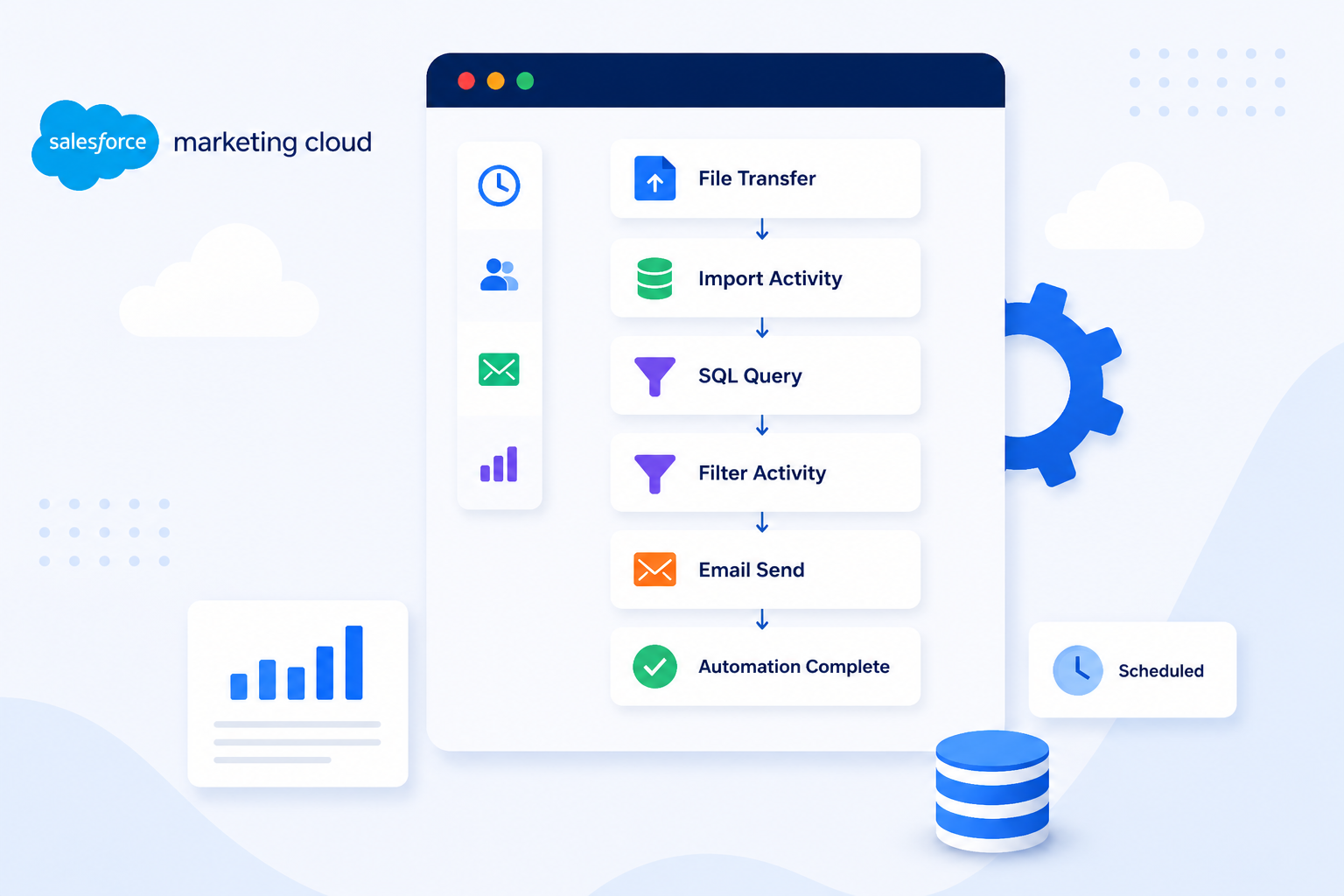
Activity chaining: multiple activities run in sequence within a single automation. A typical data pipeline might import a file, run a SQL query to transform it, then send an email to the resulting segment. All in one Automation Studio workflow.
Data Management tools: imports, extracts, filters, query activities, and verification steps are all native activities that can be chained together.
Best for: Backend data handling, scheduled sends, ETL-type workflows, and anything that needs to run on a clock rather than in response to a customer action.
SFMC Journey Builder: Design Personalised Customer Experiences
What It Does
Journey Builder is SFMC’s customer journey orchestration tool. It is designed for real-time, behaviour-driven communication guiding individual subscribers through personalised paths based on what they do, when they do it, and what data exists about them at that moment.
Key Use Cases
- Welcome and onboarding journeys triggered by new subscriber sign-up
- Re-engagement journeys for inactive contacts
- Post-purchase follow-up sequences
- Abandoned browse or cart recovery flows
- Loyalty milestone communications
- Multichannel campaigns across email, SMS, push notifications, and advertising audiences
Key Features
Journey Canvas: a visual drag-and-drop interface for building journeys. Every path, decision, and wait step is visible and editable without touching code.
Multiple entry sources: contacts enter journeys via data extensions, Salesforce CRM events, API events, or CloudPages form submissions.
Decision splits: route contacts down different paths based on data attributes or engagement behaviour. A contact who clicks gets one path; a contact who opens but does not click gets another.
Wait activities: hold contacts for a set duration or until a specific date before the next step fires.
Goals and exit criteria: define what success looks like (a purchase, a click, a data field update) and Journey Builder will exit contacts automatically when they achieve it.
Multichannel activities: send email, SMS, push notifications, or trigger Salesforce CRM tasks from within a single journey canvas.
Best for: Customer-facing, behaviour – triggered communication across the customer lifecycle.
Automation Studio vs Journey Builder: Key Differences
| Feature | Automation Studio | Journey Builder |
|---|---|---|
| Primary purpose | Data & task automation | Customer journey orchestration |
| Triggered by | Schedule, file drop, API | Customer behaviour, data events, API |
| Customer interaction logic | No | Yes: decision splits, wait steps, goals |
| Email sends | Yes | Yes |
| SQL query execution | Yes | No |
| Data import / export | Yes | No |
| Multichannel (SMS, push, ads) | No | Yes |
| Behavioural targeting | No | Yes |
| Real-time personalisation | Limited | Yes via entry data and AMPscript |
| Visual canvas | No | Yes |
The core distinction: Automation Studio runs on a clock. Journey Builder runs on a customer.
When to Use Each: A Decision Framework
| Scenario | Use This Tool |
|---|---|
| Send a daily email newsletter to a scheduled segment | Automation Studio |
| Onboard new subscribers with a triggered welcome sequence | Journey Builder |
| Run weekly SQL queries to refresh engagement segments | Automation Studio |
| Re-engage contacts who have not opened in 90 days | Journey Builder |
| Import CRM data into SFMC every night via SFTP | Automation Studio |
| Trigger a follow-up email when a contact abandons a cart | Journey Builder |
| Extract send performance data to an external reporting tool | Automation Studio |
| Route loyalty members to different offers based on their tier | Journey Builder |
| Cleanse and deduplicate a contact data extension weekly | Automation Studio |
| Guide a new customer from first purchase to second purchase | Journey Builder |
Can You Use Both Together? Yes — And You Should
The most effective SFMC setups use Automation Studio and Journey Builder in combination, each doing what it is designed for, feeding into the other.
A common pattern: Automation Studio runs a nightly SQL query that identifies contacts who meet re-engagement criteria and writes them to a data extension. Journey Builder watches that data extension as an entry source and fires a personalised re-engagement sequence the moment a contact appears. Automation Studio handled the data logic. Journey Builder handled the customer experience.
Another example: Automation Studio imports daily transaction data from your e-commerce platform into a purchases data extension. Journey Builder reads that data extension to trigger post-purchase journeys, route customers based on purchase value, and suppress recent buyers from promotional sends.
Neither tool alone covers the full picture. Together, they cover the entire marketing automation stack.
For a broader look at how these tools fit into a high-performing SFMC operation, the SFMC best practices guide covers the governance and architecture decisions that make both tools work at scale.
Conclusion
Automation Studio and Journey Builder are not competitors, they are complements. Automation Studio is your data infrastructure engine: reliable, scheduled, backend. Journey Builder is your customer experience layer: real-time, behaviour – driven, multichannel.
The teams getting the most out of SFMC use both deliberately, Automation Studio to keep data clean and current, Journey Builder to act on that data in ways that are relevant to each individual customer.
If you want help designing an automation architecture that uses both tools effectively for your specific use case, get in touch →
References: Automation Studio — Salesforce Help Journey Builder — Salesforce Help