
Not every AI tool earns its place in your stack. According to McKinsey, AI creates more value in marketing and sales than any other business function — but only for teams choosing the right tools.
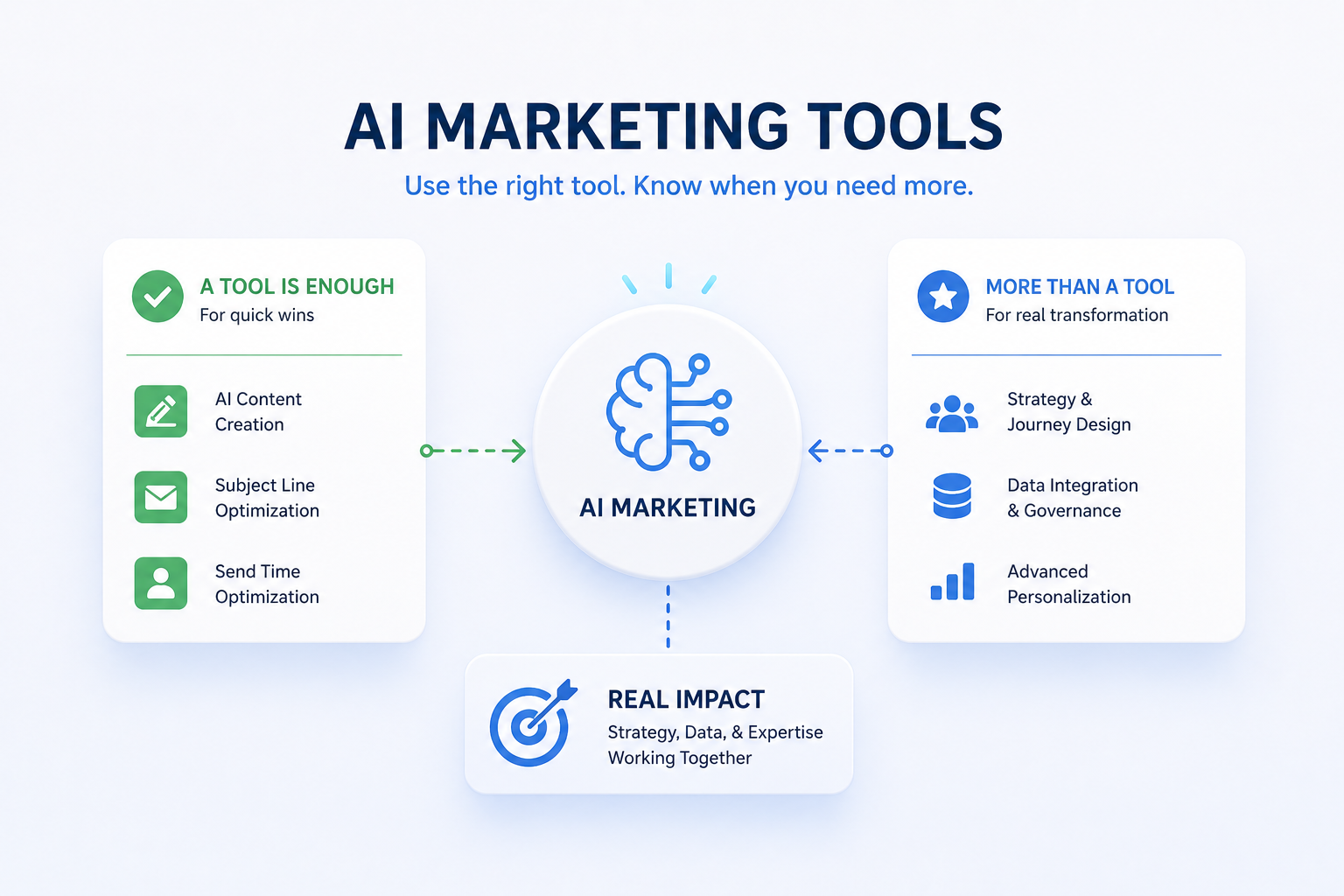
This guide breaks down the most effective AI marketing tools by use case, and when point solutions stop being enough.
AI Tools for Content Creation
Jasper AI — Best for teams needing brand-consistent content at scale. Strong Brand Voice feature, but no customer-level personalization.
Copy.ai — Best for short-form output: subject lines, ad copy, CTAs. Now includes workflow automation to connect content generation to CRM data.
AI Tools for SEO
Surfer SEO — Analyzes live SERPs and recommends structure, keywords, and word count. Updated to optimize for Google’s AI Overviews alongside traditional rankings.
Semrush AI Writing Assistant — Combines keyword data with content generation. Useful for teams that want research and writing in one workflow.
AI Tools for Email Marketing
Klaviyo — Dominant for ecommerce and DTC. Predictive analytics for purchase timing, behavioral segmentation, and individual-level send time optimization. Not built for B2B or complex multi-channel journeys.
Mailchimp — Most accessible for SMBs. Covers the basics: send-time prediction, content optimization, campaign recommendations.
Phrasee — Specializes in AI-generated subject lines and email copy with documented open rate lift. Plugs into your existing ESP.
AI Tools for Social and Paid Ads
Hootsuite — Scheduling, sentiment analysis, and AI caption generation across multiple brand accounts.
Albert.ai — Automated media buying for brands spending $50K+/month. Continuously optimizes ROAS across channels without manual input.
AI Tools for Customer Intelligence
Brandwatch — Processes social conversations and digital signals to surface brand sentiment, trends, and competitive intelligence at scale.
Gumloop — Connects LLMs to internal tools without code. Used by teams at Shopify and Webflow for sentiment analysis, lead enrichment, and content pipelines.
The Real Problem: Fragmented Data
Most marketing teams aren’t short on tools — they’re running 20+ of them. The problem is that each tool holds a piece of the customer picture, and none of them talk to each other.
When data is siloed, personalization becomes guesswork. AI is only as smart as the data feeding it.
Signs you’ve hit the ceiling of standalone tools:
- Marketing, sales, and service each see a different version of the same customer
- Customer journeys break between touchpoints — email, web, chat feel disconnected
- Managing 5+ channels at scale creates more overhead than the tools save
- Compliance requirements need centralized data control, not 10 separate platforms
Why Salesforce Marketing Cloud Is Built for This
SFMC isn’t another tool to add to your stack. It’s the platform that makes all your marketing data, execution, and analytics work together — across the entire customer lifecycle.
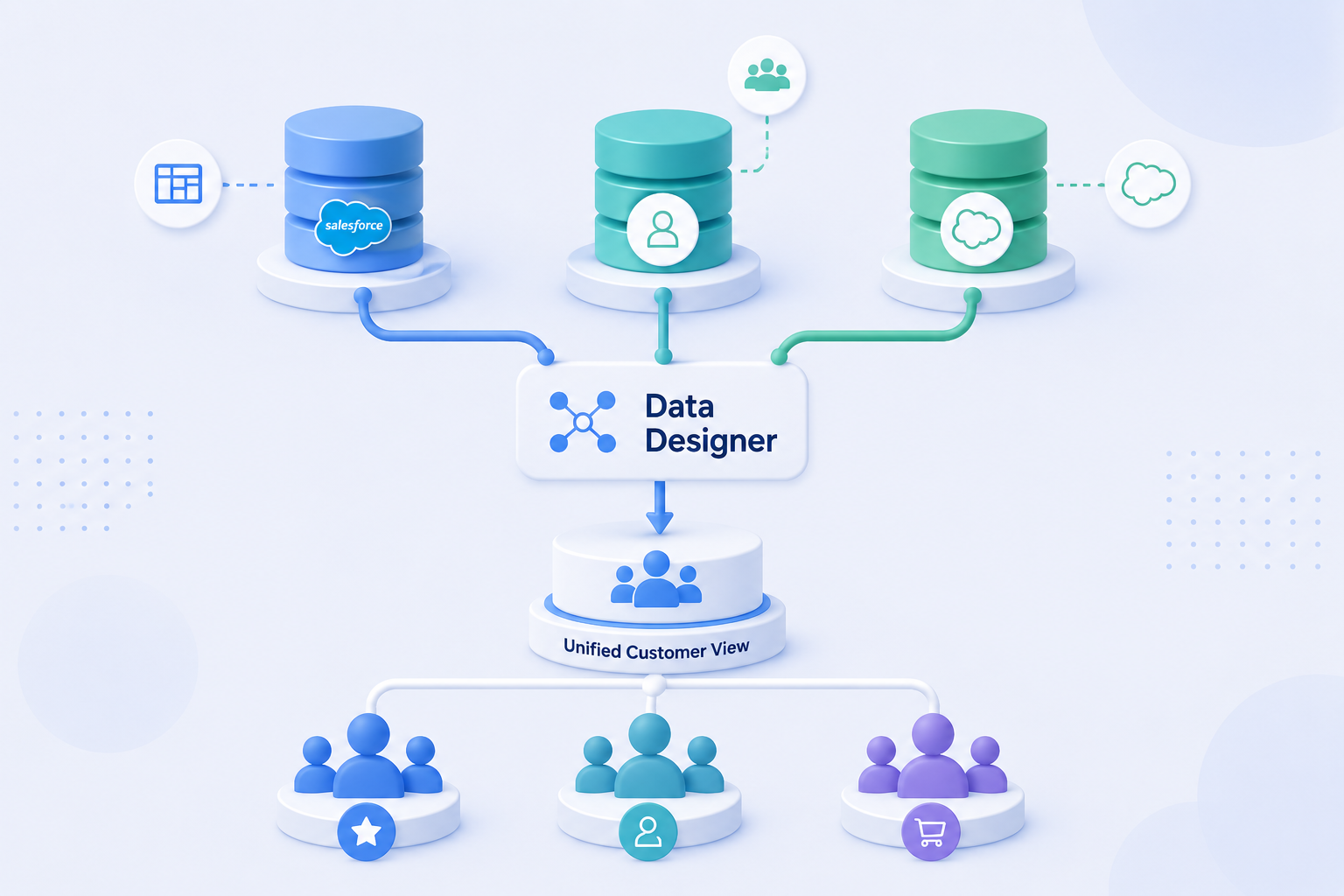
Data Cloud unifies every data source — web behavior, email engagement, purchase history, CRM records — into one customer profile. This is what gives AI the complete picture it needs to be accurate, not approximate.
Agentforce goes beyond content generation. It acts on live customer data to automatically segment audiences, personalize messages, and trigger the right action on the right channel — without manual steps at each stage.
Journey Builder orchestrates complex multi-channel journeys across email, SMS, push, ads, and web — with branching logic that adapts in real time based on how each customer responds. See how it works: What Is Salesforce Journey Builder?
Einstein AI runs throughout the platform — Send Time Optimization, Content Selection, Predictive Scoring — so every campaign decision is backed by machine learning, not gut feel.
SFMC is the right fit when:
- You’re on Salesforce CRM and want marketing and sales working from the same data
- Your database is 100,000+ contacts with complex segmentation needs
- You need true multi-channel orchestration, not just email with extras
- You want a platform that scales with the business long-term
The Bottom Line
Standalone tools solve individual problems well. But when you need them to work together — unified data, seamless journeys, AI that actually knows your customer — that’s when a platform like Salesforce Marketing Cloud becomes the answer.
Point solutions solve individual problems. Integrated platforms solve growth.
Want to go deeper?