
AI in Salesforce Marketing Cloud is real, well-documented, and genuinely useful in specific scenarios. It is also regularly overpromised.
If you have been told that enabling Einstein will transform your marketing performance, or that AI removes the need for data strategy and platform expertise, this article is a more honest version of that conversation.
What AI Actually Means in SFMC
When people refer to AI in SFMC, they are almost always referring to Einstein: a suite of separate features within Marketing Cloud Engagement, each designed to solve a specific optimization problem.
Einstein is not a single switch you turn on. It is not a chatbot. It does not read your briefs or write your emails. Each Einstein feature does one thing, requires its own setup, and depends on your account having sufficient historical data before predictions become reliable.
Not every SFMC account has Einstein features enabled. Some require separate licensing. None of them operate well without clean, structured, and sufficient data.
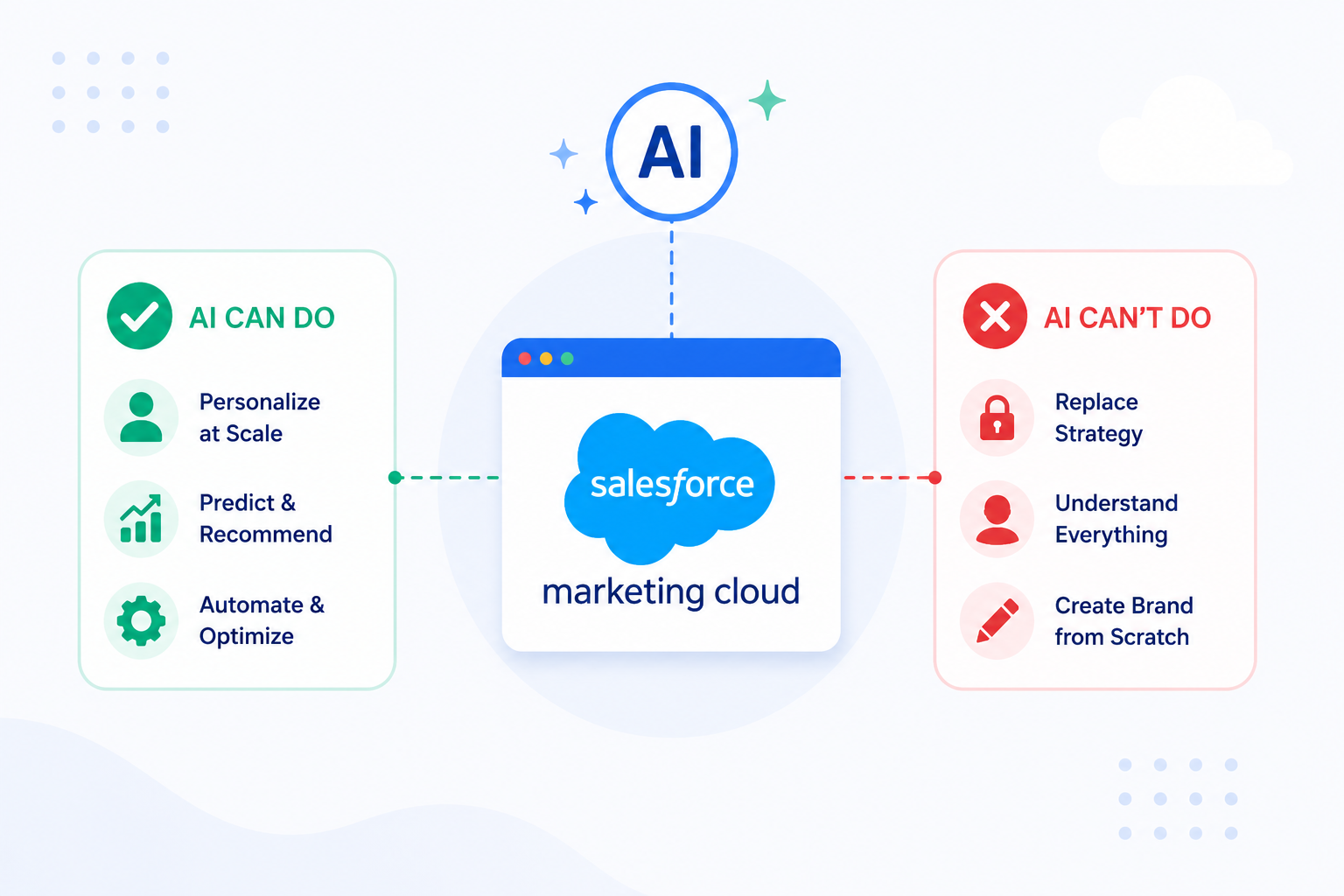
What AI Can Do in SFMC
Optimize send timing per subscriber
Einstein Send Time Optimisation (STO)* analyses 90 days of engagement data to predict the best time to send to each individual contact, based on when they have historically been most likely to open. (Salesforce Help)
This is one of the most widely used and well-validated Einstein features. It works in Journey Builder and Email Studio, and it operates at the individual contact level rather than sending everyone at the same scheduled time.
Score contacts by engagement likelihood
Einstein Engagement Scoring* analyses subscriber behaviour and assigns each contact a score predicting their likelihood to open, click, stay subscribed, or convert. Contacts are grouped into personas: Loyalists, Window Shoppers, Selective Subscribers, and Winback/Dormant.
These scores populate a data extension named Einstein_MC_Predictive_Scores and can feed decision splits in Journey Builder, suppression logic, and re-engagement campaigns. (Salesforce Help)
Note: Einstein Engagement Scoring requires at least 1,000 engagement events in the 90 days before activation. It must be enabled in Setup and is not on by default.
Surface subject line insights
Einstein Copy Insights* analyses the text of your sent subject lines against engagement outcomes and surfaces language patterns associated with stronger performance for your specific audience. It assesses a rolling 90-day window and requires at least 10 different subject lines sent to at least 30 subscribers within a 30-day period to populate.
This feature does not write subject lines. It identifies what has worked historically and why. You still write and decide.
Select content dynamically at open time
Einstein Content Selection* picks the most relevant content asset for each subscriber at the moment they open an email, based on their behavioural and affinity data. It requires separate enablement and sufficient data volume before predictions become reliable.
Identify optimal send frequency
Einstein Engagement Frequency evaluates your contacts and recommends the optimal number of messages to send, helping avoid both under-communication and burnout. It classifies contacts into four categories: receiving too many emails, close to saturation, at ideal frequency, and under-engaged.
What AI Cannot Do in SFMC
Replace data strategy
Every Einstein feature runs on your data. If your contact model is poorly structured, your data extensions are inconsistent, or your send history is thin, Einstein has nothing reliable to work with. AI is a multiplier of what already exists, not a fix for what is broken.
Write your content
Einstein does not generate email copy, subject lines, creative assets, or journey logic. It analyses and optimises. Content creation is a separate problem that tools like ChatGPT address. Einstein does not.
Build or design your journeys
Journey architecture, channel strategy, and campaign logic are human decisions. Einstein can feed data into a journey and optimise delivery within one, but it does not design the journey or decide what the customer experience should be.
Compensate for bad data architecture
If your subscriber keys are inconsistent, your data extensions are duplicated, or your Contact Builder* configuration is incorrect, Einstein predictions will be unreliable or simply unavailable. Fixing data architecture is a prerequisite, not something AI resolves on its own.
Produce reliable predictions without volume
Einstein Engagement Scoring requires at least 1,000 events in 90 days before activation. Einstein STO requires sufficient send history before individual-level predictions are meaningful. Einstein Copy Insights requires at least 10 subject lines sent to 30 or more subscribers within a 30-day window. Accounts with low send volume or recent platform migrations will see limited value from AI features until that baseline is established.
Replace human judgment
Einstein surfaces insights and recommendations. It does not interpret them, decide what action to take, or account for business context, brand voice, or strategic priorities. A team that cannot read and act on AI output will not get value from AI features.
The Gap Between Expectation and Reality
The most common pattern: an organisation enables Einstein, sees the dashboards populate, and then does not change anything about how campaigns are built or sent. Six months later, there is no measurable impact.
AI in SFMC requires deliberate integration into workflow. Einstein STO only delivers value if sends are actually scheduled using its recommendations. Einstein Engagement Scoring only improves results if scores are used to segment, suppress, or route contacts differently. Turning features on is not the same as using them.
What You Need in Place Before AI Adds Value
- Clean, consistent contact data: subscriber keys must be stable and consistent across channels; duplicate or fragmented contact records produce unreliable scores
- Sufficient send history: most Einstein features require 90 days of engagement data before predictions are meaningful; accounts below minimum volume thresholds will see limited output
- Defined optimization goals: Einstein optimises toward something: open rate, click rate, conversion. You need to define what success looks like before AI can move toward it
- A team that can act on insights: AI generates recommendations, not decisions; someone needs to read the output, interpret it in context, and change what gets built and sent
Going Deeper
- Salesforce Einstein AI: Every Feature in SFMC Explained
- ChatGPT vs Salesforce Einstein: What Marketers Need to Know
- 10 Signs Your Marketing Automation Needs an Audit
- Salesforce Marketing Cloud Best Practices That Actually Work
Wondering whether your SFMC setup is ready to get value from Einstein? Talk to our team.
Glossary
Contact Builder: the SFMC tool used to define and manage the contact data model, including relationships between data extensions and the All Contacts record. A correctly configured contact model is a prerequisite for Einstein features that rely on contact-level predictions.
Einstein Content Selection: an Einstein feature that selects the most relevant content asset for each subscriber at open time, based on behavioural and affinity data. Requires separate enablement and sufficient data volume before predictions are reliable.
Einstein Copy Insights: an Einstein feature that analyses subject line text against engagement outcomes to surface language patterns associated with stronger performance. Requires at least 10 subject lines sent to 30 or more subscribers within a 30-day window. English subject lines only.
Einstein Engagement Scoring: an Einstein feature that assigns each contact a score predicting their likelihood to engage with email or push messaging. Requires at least 1,000 engagement events in the 90 days before activation. Must be enabled in Setup; not on by default.
Einstein Engagement Frequency: an Einstein feature that recommends the optimal number of messages to send to each contact, classifying contacts into four frequency categories to help avoid over- or under-communication.
Einstein Send Time Optimisation (STO): an Einstein feature that uses 90 days of engagement data to predict the optimal send time for each individual contact. Available in Journey Builder and Email Studio.
Predictive AI: a category of AI that uses historical data to forecast future outcomes or behaviour. Salesforce Einstein is a predictive AI suite. It is distinct from generative AI tools like ChatGPT, which produce new content rather than making predictions.