
Both are described as AI. Both are being pushed by vendors as the future of marketing. And both are showing up in the same conversations about how to do more with less.
But ChatGPT and Salesforce Einstein do fundamentally different things. Understanding that difference matters if you are trying to make practical decisions about how to use AI in your marketing operations, particularly if you are running campaigns in Salesforce Marketing Cloud (SFMC).
What They Actually Are
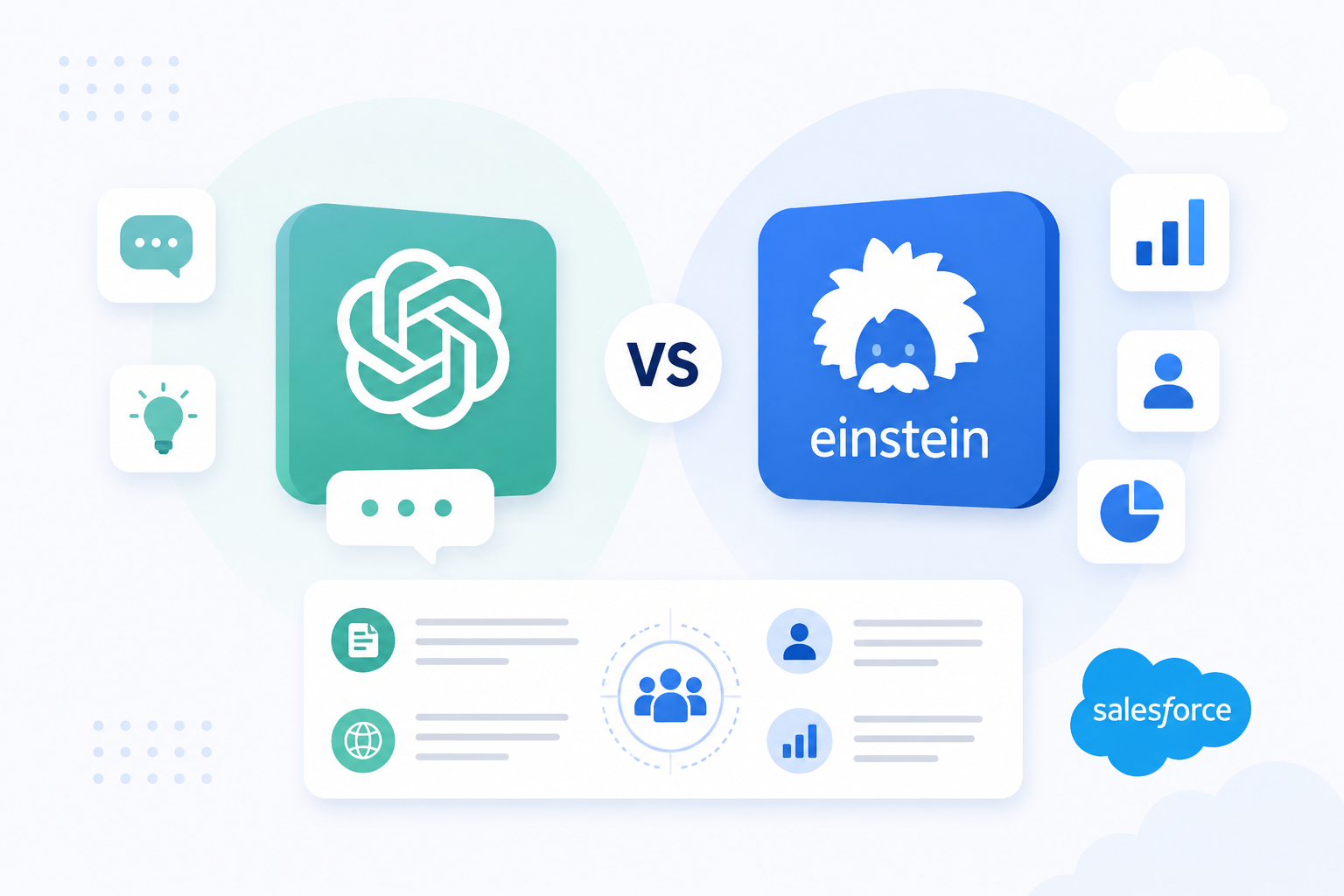
ChatGPT is a generative AI* tool built by OpenAI. It produces text in response to prompts. Give it a brief, and it will write a subject line, draft an email, summarise a document, or answer a question. It does not need your customer data to work. It has no connection to your marketing platform by default.
Salesforce Einstein is not a single tool. It is a suite of AI capabilities built into the Salesforce ecosystem, including SFMC. It uses your existing data (subscriber behaviour, send history, engagement patterns) to make predictions and optimise outcomes. It does not generate content from scratch. It works on top of data you already have.
One is a content engine. The other is a data engine.
What ChatGPT Is Good at for Marketers
ChatGPT is useful at the content creation stage, particularly for speed and volume:
- Drafting at pace: subject line variations, email body copy, SMS messages, and social captions in minutes rather than hours
- Brainstorming: generating angles, campaign concepts, or messaging frameworks when you are starting from a blank page
- Rewriting and adapting: taking existing content and adjusting tone, length, or audience without starting over
- Ad hoc research: summarizing industry topics, explaining concepts, or answering strategic questions quickly
What it cannot do: ChatGPT has no access to your customer data, your campaign history, or your platform. Every output needs human review before it goes anywhere near a live send. It produces plausible text, not necessarily accurate or on-brand text.
What Salesforce Einstein Is Good at for Marketers
Einstein operates inside your platform, on your data. Its value is in optimisation and prediction, not creation:
- Einstein Send Time Optimisation (STO):* predicts the best time to send to each individual subscriber based on their historical engagement patterns, rather than sending everyone at the same time
- Einstein Content Selection:* automatically selects the most relevant image or content block for each subscriber at open time, based on their behaviour and affinity data. This feature requires separate enablement and sufficient behavioural data volume to generate reliable predictions. It is not active by default in all SFMC accounts
- Einstein Engagement Scoring:* scores contacts by their likelihood to engage, open, or convert, which feeds smarter segmentation and suppression decisions
- Einstein Copy Insights:* analyses subject line performance across your sends and surfaces patterns about what language drives engagement for your audience
What it cannot do: Einstein cannot write your emails, generate ideas, or operate without sufficient data volume. Most Einstein features require a meaningful send history before predictions become reliable. It also does not replace strategy or creative judgment.
The Key Difference
ChatGPT decides what to say. Einstein decides who receives it, when, and in what form.
They operate at different points in the marketing workflow. That is why the comparison is slightly misleading when posed as either/or. They are not competing for the same job.
Can You Use Both Together?
Yes, and many teams already do:
- Use ChatGPT to generate multiple subject line variants quickly
- Use Einstein Copy Insights to evaluate which language patterns have historically performed well for your audience
- Use Einstein STO to deliver the winning version at the optimal time for each subscriber
The combination works because each tool covers a gap the other leaves open. ChatGPT accelerates content production but cannot personalise at scale. Einstein personalises at scale but cannot produce the content in the first place.
The risk to watch: over-relying on ChatGPT output without review. Generative AI produces fluent, confident text that may be off-brand, factually incorrect, or tone-deaf for a specific segment. Human review before any live send is not optional.
What This Means for Your SFMC Workflow
A practical way to think about it by workflow stage:
- Planning and ideation: ChatGPT for concept generation, angle exploration, and brief writing
- Content creation: ChatGPT for drafts; human review and editing before approval
- Segmentation and audience building: Einstein Engagement Scoring to inform suppression and targeting decisions
- Send optimization: Einstein STO for delivery timing per subscriber
- Content personalization: Einstein Content Selection for dynamic content at open time
- Performance analysis: Einstein Copy Insights to inform the next round of content decisions
Neither tool eliminates the need for SFMC expertise. ChatGPT does not know how your data extensions* are structured, what your suppression logic looks like, or whether your journey entry sources are refreshing correctly. Einstein does not interpret its own outputs or decide what action to take on them. Both require a team that understands the platform to get value from them.
Going Deeper
- Salesforce Einstein AI: Every Feature in SFMC Explained
- How to Get More Out of Salesforce Marketing Cloud: Starting With Your AI Setup
- Salesforce Marketing Cloud Best Practices That Actually Work
Thinking about how AI fits into your SFMC operations? Talk to our team.
Glossary
Data extension: a table in SFMC used to store subscriber data or campaign-related information. Einstein features draw on data held in data extensions and system data views to generate predictions.
Einstein Content Selection: an Einstein feature that automatically selects the most relevant content asset (image, offer, or block) for each individual subscriber at the moment they open an email, based on their behavioural and affinity data. Requires separate enablement and sufficient data volume to generate reliable predictions — not active by default in all SFMC accounts.
Einstein Copy Insights: an Einstein feature that analyses subject line performance across your send history and surfaces language patterns associated with higher engagement for your specific audience.
Einstein Engagement Scoring: an Einstein feature that assigns each contact a score reflecting their likelihood to engage with future sends. Used to inform segmentation, suppression, and re-engagement decisions.
Einstein Send Time Optimisation (STO): an Einstein feature that predicts the optimal send time for each individual subscriber based on their historical open and click patterns. Available in Journey Builder and Email Studio.
Generative AI: a category of AI that produces new content (text, images, code) in response to prompts. ChatGPT is a generative AI tool. Salesforce Einstein is not; it is a predictive and optimization AI suite.