
Most marketing teams think about consent management once — when they set up their unsubscribe link. Then they move on.
That’s a problem. Because in Salesforce Marketing Cloud, how you handle consent doesn’t just affect legal compliance. It affects deliverability, data quality, customer trust, and whether your journeys actually reach the right people.
This article is for anyone working with SFMC — whether you’re running campaigns, managing the platform, or making decisions about how your team uses it. No legal jargon. Just a clear look at why consent management deserves more attention than it’s getting.
What Consent Management Actually Means in SFMC
Consent management is the system that controls who can receive your messages, through which channels, and for what purpose — and ensures that permission is properly captured, stored, and respected every time a message goes out.
In SFMC, this covers:
- Email — opt-in/opt-out status stored in All Subscribers and Publication Lists
- SMS — keyword-based opt-ins managed in MobileConnect
- Push notifications — opt-in status handled in MobilePush
- Ads — suppression based on consent flags
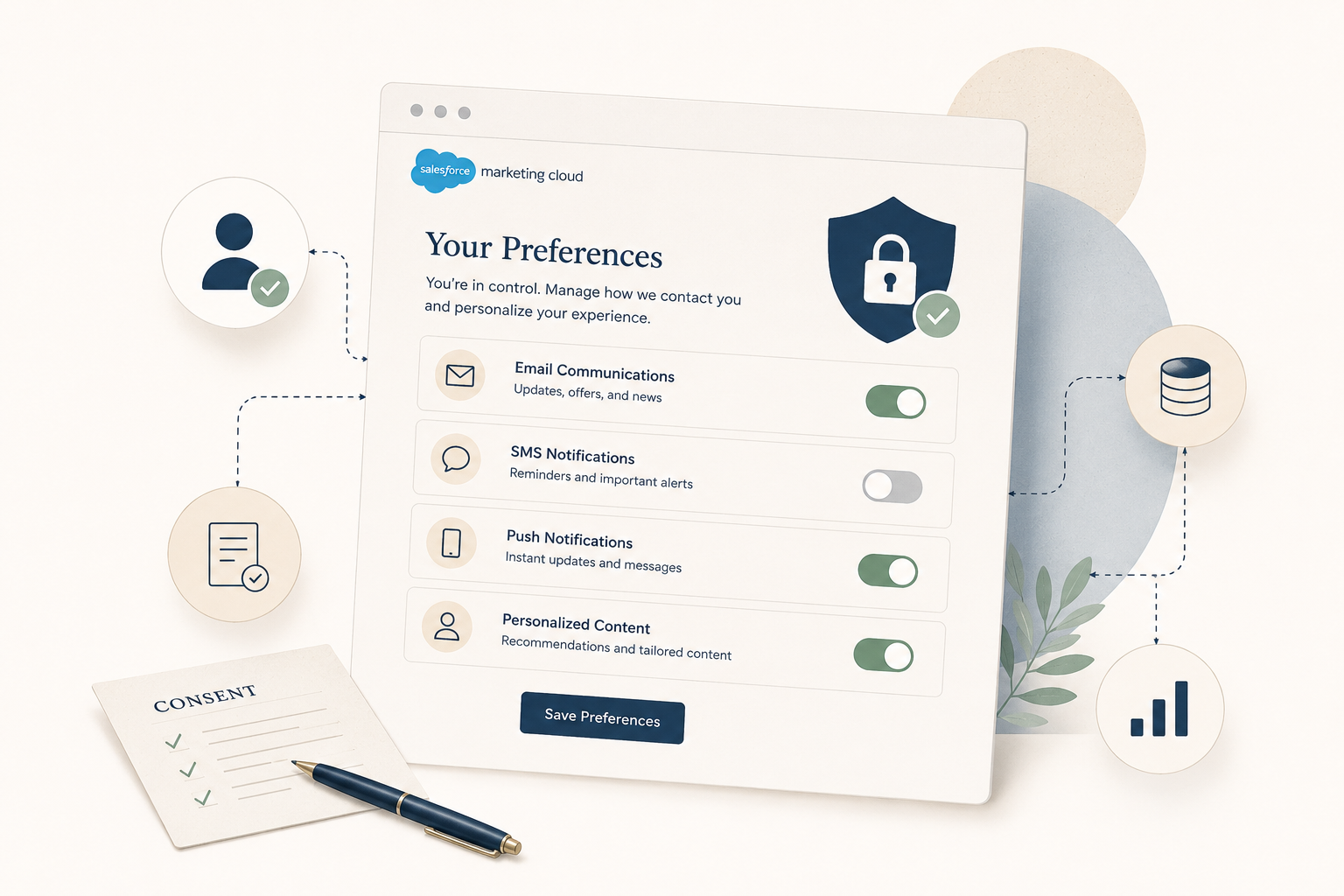
- Preference centers — letting contacts choose topics, frequency, and channel
It sounds straightforward. In practice, it breaks down quietly — and often goes unnoticed until something goes wrong.
Why Most Teams Underestimate It
Here’s the honest reality: consent management is invisible when it’s working and catastrophic when it isn’t.
Teams that underinvest in it typically run into one or more of these situations:
Deliverability drops with no clear cause. Sending to contacts who never properly opted in — or who opted out on one channel but not another — increases spam complaints and suppression rates. Inbox providers notice. Over time, even your engaged contacts stop seeing your emails.
Journey Builder sends to the wrong people. If consent isn’t checked at the data level before contacts enter a journey, SFMC’s built-in suppression catches some cases — but not all. Contacts on the wrong publication list, or with inconsistent opt-in flags across systems, can slip through.
Compliance audits become stressful. GDPR, PDPA, CCPA, and similar regulations don’t just require you to honor opt-outs — they require you to prove you did, with timestamps, capture method, and source system. If that data isn’t structured properly in SFMC, you’re reconstructing it under pressure.
Preference centers erode trust instead of building it. A preference center that doesn’t actually reflect what a contact receives — or doesn’t save changes properly — is worse than not having one. Contacts who update their preferences and still receive irrelevant messages disengage faster than those who never had the option.
How SFMC Handles Consent — and Where Teams Get It Wrong
SFMC has strong native tools for consent management. The gap is usually in how they’re configured and maintained.
All Subscribers is the master opt-out list for email. Any contact with an Unsubscribed or Held status here will not receive email regardless of what any other list says. Most teams know this. Fewer teams audit it regularly or understand how external system updates interact with it.
Publication Lists let you manage consent by communication type — newsletters, transactional messages, product updates, and so on. Done correctly, they give contacts granular control. Done poorly, they become a patchwork that’s hard to reason about and harder to audit.
Subscription and Preference Centers built on CloudPages allow contacts to self-manage their preferences in real time. The technical implementation matters enormously here — preference updates need to write back to the right data extensions, trigger the right automations, and sync to external systems where relevant.
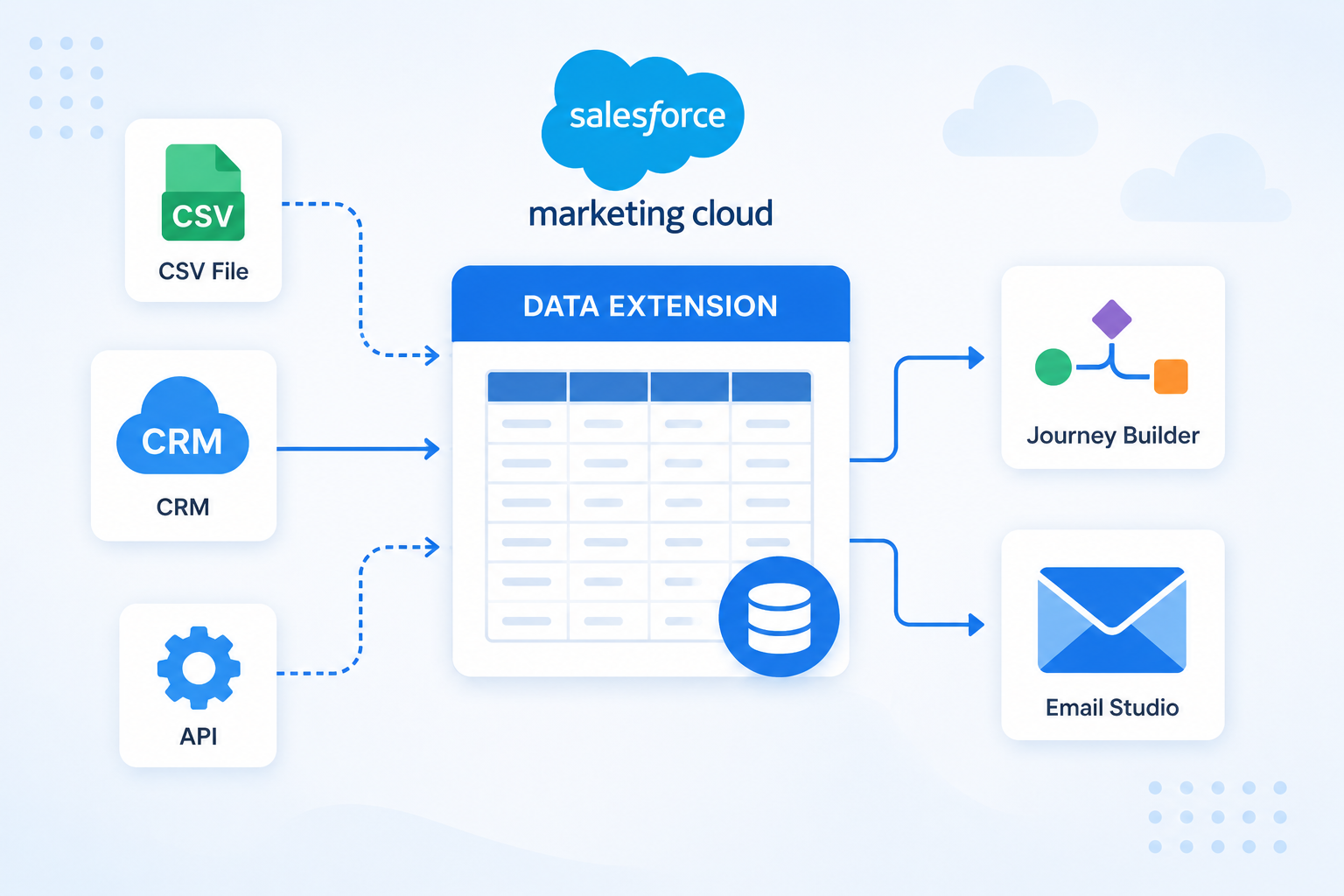
Data Extensions with consent flags are how many teams track channel-specific or purpose-specific consent beyond email. A field like HasOptedIn = True can be used as a Decision Split condition in Journey Builder, giving you an explicit consent gate before any send activity — and a clear audit trail of how many contacts were filtered and why.
API-driven consent syncing matters most in multi-system environments. If consent is captured on your website, in your CRM, or through a third-party form, that update needs to reach SFMC quickly and reliably. Delays or failures in consent sync create windows where contacts can be messaged after they’ve withdrawn permission — exactly the scenario regulators look for.
The Trust Argument (Beyond Compliance)
Compliance is the floor, not the ceiling.
The teams getting the most out of SFMC aren’t just avoiding violations — they’re using consent infrastructure to send better, more relevant communications that perform better because they’re reaching people who actually want them.
When a contact updates their preference center and then receives exactly what they asked for — at the right frequency, on the right channel — that’s a moment of trust. When a contact unsubscribes from one topic but stays subscribed to another, and you honor both correctly, that’s retention.
The inverse is also true. Brands that batch-and-blast to every address in their database, ignore preference updates, or treat unsubscribes as a metric to minimize are trading short-term send volume for long-term list health and sender reputation.
Consent management, done well, is an investment in the quality of your audience — not a tax on your send volume.
What Good Consent Management Looks Like in Practice
Regardless of your team’s size or technical maturity, these principles hold:
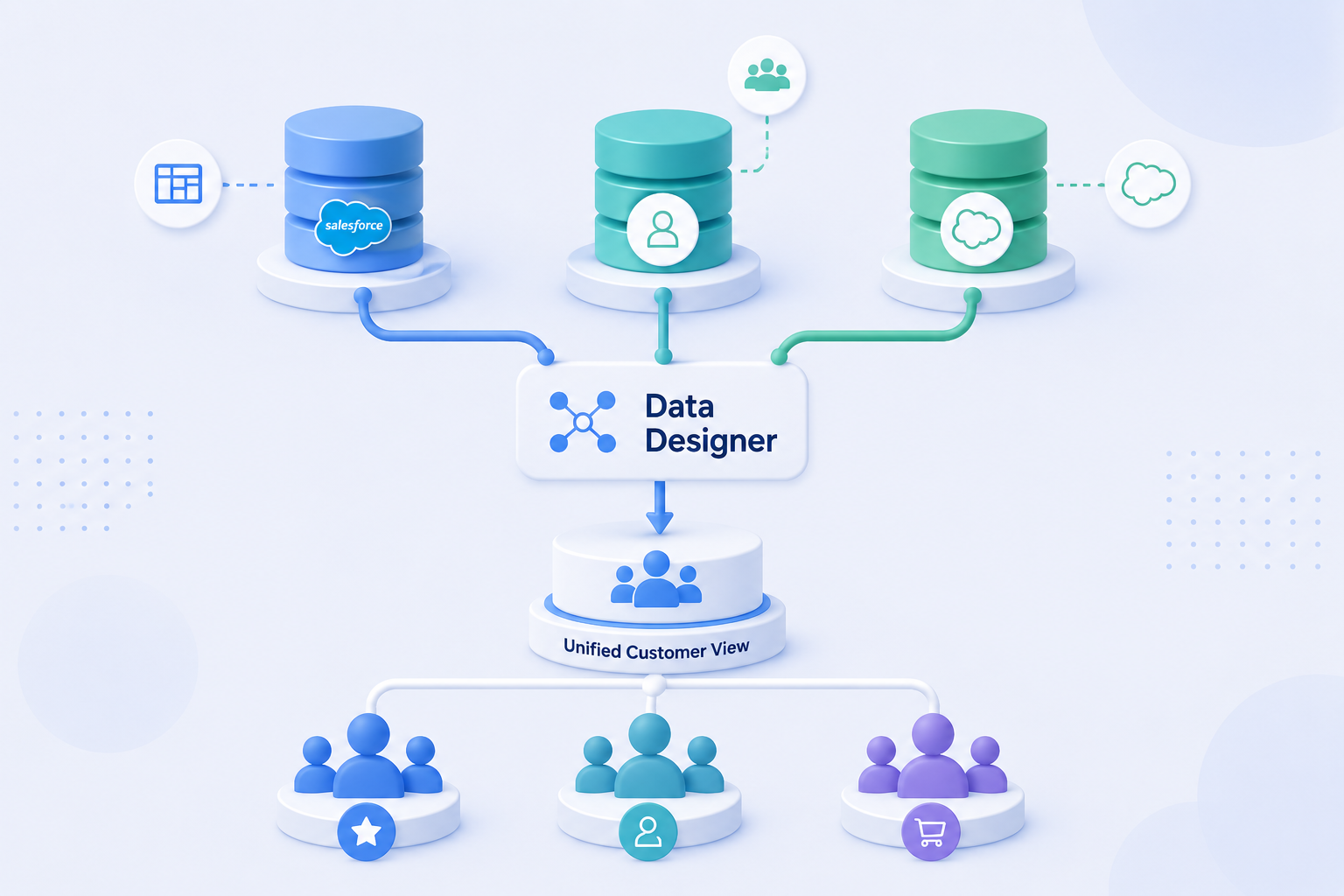
One consistent contact key across all studios and builders. Fragmented identity is the root cause of most consent management failures. If the same person has different identifiers in Email Studio, MobileConnect, and your CRM, honoring their preferences across channels becomes structurally impossible.
Consent captured with context. Store not just the opt-in flag, but when it was captured, how (form, keyword, API), and from which system. This is what makes an audit defensible.
Preference center changes that actually work. Test them. Verify that updates write back correctly. Check that the experience on mobile is functional. A preference center that silently fails is a compliance liability.
Regular audits of your All Subscribers list and publication lists. Stale data, duplicate contacts, and inconsistent statuses accumulate over time. Quarterly reviews catch problems before they affect deliverability or compliance.
Consent checks in journeys for high-stakes communications. Don’t rely solely on SFMC’s built-in suppression for sensitive sends. An explicit Decision Split checking a consent flag adds transparency and auditability.
Getting Consent Right Is Getting Marketing Right
Consent management isn’t glamorous. It doesn’t show up in campaign performance reports or get highlighted in quarterly reviews. But it underpins everything that does — deliverability, personalization, journey performance, and the trust that makes customers stay subscribed in the first place.
In SFMC, the tools are there. The question is whether they’re configured with enough care and maintained with enough consistency to do the job they’re supposed to do.
If you’re not sure where your current setup stands, that’s usually the right place to start.
Related reading: