

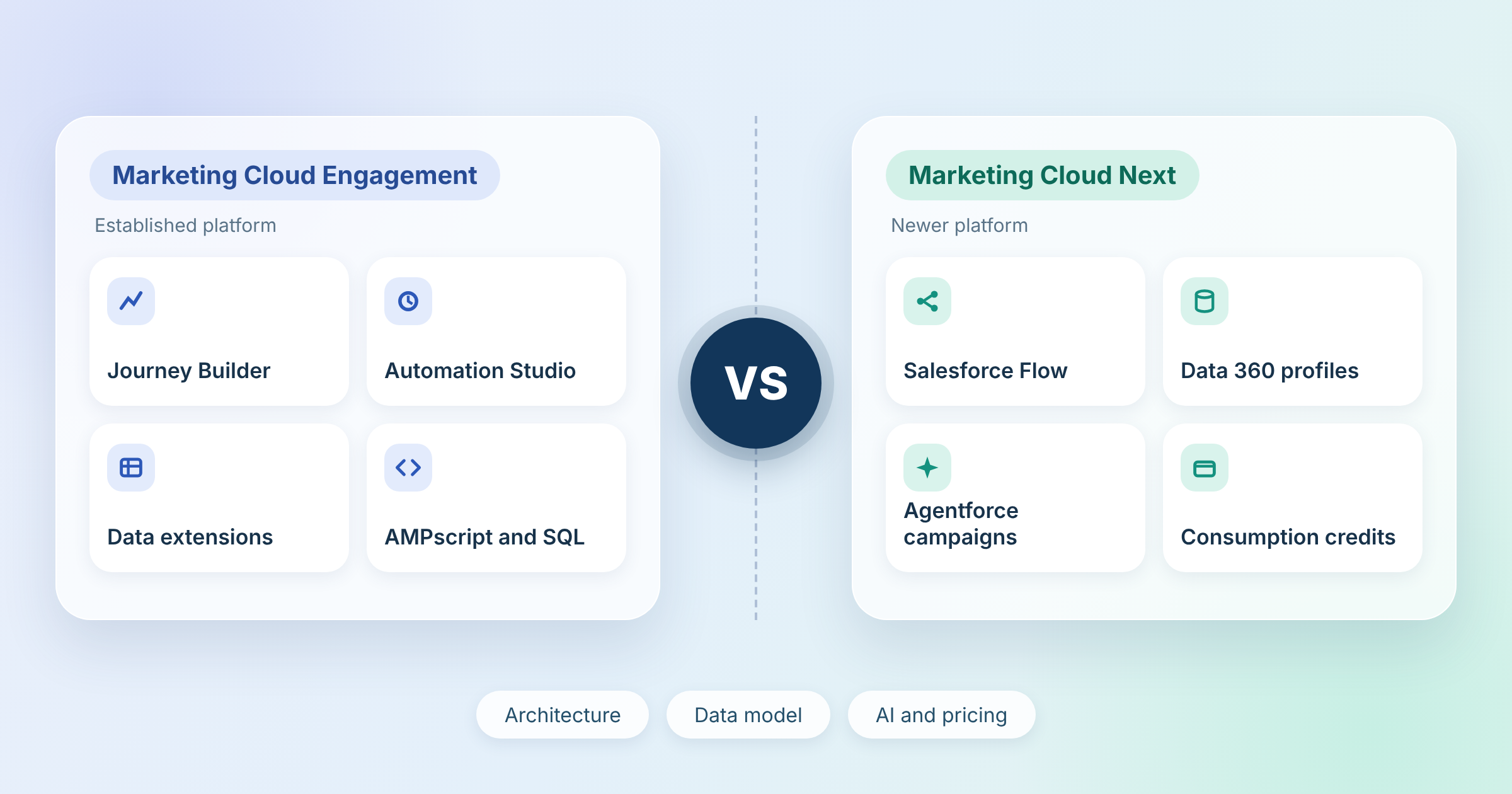
Marketing Cloud Next vs Marketing Cloud Engagement is a question many Salesforce marketing teams are asking right now. Both are Salesforce marketing platforms. They run on different architectures, use different data models and suit different teams. Neither is simply the “better” one.
This guide compares the two on the points that matter most: architecture, data, orchestration, AI, pricing and fit. It also covers the situations where each platform makes more sense. Last reviewed: October 2026.
The Short Version
Marketing Cloud Engagement* is the established platform, built on ExactTarget technology and run separately from core Salesforce. Marketing Cloud Next* is the newer platform, built natively on the Salesforce platform with Data 360* as its data layer.
Engagement offers deep, scriptable control for teams with strong SQL and AMPscript* skills. Next offers real-time data, Flow-based orchestration and built-in AI for teams with a mature data foundation. Salesforce states that there are no end-of-life, end-of-sale or end-of-roadmap plans for Engagement. (Salesforce) As a result, many teams face a timing decision rather than a forced move.
Marketing Cloud Next vs Marketing Cloud Engagement: Key Differences
| Area | Marketing Cloud Engagement | Marketing Cloud Next |
|---|---|---|
| Architecture | Runs on its own infrastructure, separate from core Salesforce | Built into the Salesforce platform, with Data 360 as the foundation |
| Data model | Data extensions* and lists, often synced in batches | Unified profiles in Data 360 with identity resolution |
| Orchestration | Journey Builder and Automation Studio | Campaigns and journeys built on Salesforce Flow* |
| Customisation | AMPscript, SQL and server-side JavaScript | Flow and Data 360, with AMPscript support added for email in Summer ’26 |
| AI | Einstein features that sit on top of the platform | Agentforce* built into campaign creation, segmentation and journeys |
| Business Units | Business Units inside one account | Data spaces in Data 360 and Business Units sold as add-ons |
| Pricing model | Contract based, negotiated with Salesforce | Edition prices plus consumption based credits |
(Mavlers) (Purple Square) (Salesforce Ben)
Read the table as a direction of travel. It describes how each platform is designed, not a feature checklist where one side wins every row.
Architecture and Data
Engagement keeps marketing data in its own environment. Teams design data extensions as custom tables and sync CRM data through Marketing Cloud Connect or imports. This gives marketers a lot of freedom. It also means data is often synced in batches.
Next reads from Data 360, which Salesforce describes as unifying customer touchpoints into real-time profiles. Marketing sits on the same data layer as sales and service. Mavlers notes that Business Units map to Data 360 data spaces, so separating operations means planning separate data spaces. (Mavlers)
Data quality matters more in Next. Mavlers describes data maturity as having more influence on outcomes than the AI features do. Mavlers also reports that data cleanup often takes longer than teams budget for. (Mavlers)
Orchestration and Customisation
Engagement orchestrates through Journey Builder and prepares data through Automation Studio. Teams extend both with AMPscript, SQL and server-side JavaScript. This suits technical teams who want fine control.
Next runs campaigns and journeys on Salesforce Flow, the same automation engine used across other Salesforce clouds. It is designed for event-driven reactions across marketing, sales and service. (Purple Square) Salesforce’s own FAQ describes Flow as the successor to Journey Builder for Next and says existing Journey Builder journeys can be used within Flow. (Salesforce)
Summer ’26 narrowed the gap. AMPscript now works alongside Handlebars in Next email content. Forms, lists and signup flows also gained features that reduce reliance on CloudPages. (Salesforce Ben) Existing scripts still need review, because long-running Engagement accounts often depend on data extensions that have no direct structure in Next. (Blueport)
AI Capabilities
Engagement uses Einstein features such as send time optimisation and engagement scoring. These work on top of data you already hold.
Next builds Agentforce into the platform. For example, Agentforce can turn a campaign goal into a brief, an audience and a send. It also supports plain-language segmentation. (Mavlers)
Keep expectations realistic. Mavlers reports that human approvals and timing still sit with the team. Scoring can also appear without a clear explanation, so results need checking. Mavlers also notes that the deep personalisation skilled teams build by hand in Engagement is not yet matched automatically. (Mavlers)
Channels
Both platforms support email. On its pricing page, Salesforce lists SMS and WhatsApp for Next as add-ons and RCS and conversational messaging in the Advanced edition. (Salesforce) Engagement supports email, mobile and web channels.
Channel coverage is not identical, and some sources describe it differently. Check each channel you rely on, including push, advertising and social, against your Salesforce contract before you decide.
Pricing Models Compared
The two platforms charge in different ways, so a direct price comparison can mislead.
Salesforce lists Marketing Cloud Next Growth at $1,500 and Advanced at $3,250 per org per month, billed annually. Consumption items sit on top: Data 360 profiles from $240 per 1,000, messaging credits per 1,000, additional Business Units per month and the Campaign Agent add-on from $60,000 per year. (Salesforce) Salesforce describes these prices as indicative.
Engagement pricing depends on your edition, contacts and sends, and Salesforce directs buyers to a sales representative for contract details. Mavlers describes Next as harder to estimate upfront and Engagement as more predictable. (Mavlers)
For the wider budget picture, read Salesforce Marketing Cloud Implementation Cost.
Where Each Platform Fits Best
Marketing Cloud Engagement tends to fit when:
- Your team has strong SQL, data extension and AMPscript skills
- You run complex, custom-coded Journey Builder programmes
- You send high volumes of trigger-based messages
- Your data foundation is still maturing
- You rely on CloudPages applications with deep programmatic logic
Marketing Cloud Next tends to fit when:
- You want marketing, sales and service on one data layer
- Real-time segmentation is a priority
- You are starting fresh or launching a new brand or region
- Your Data 360 foundation is already licensed and governed
- Your team can build Flow and Data 360 skills
Running both can fit when:
- Different parts of the business have different needs
- You are not ready to commit to a full move
- You want to test Next while existing programmes keep running
(Mavlers) (Purple Square)
Running both is often done through an Engagement+ licence. Our guide to SFMC Plus explains how that works.
Common Misconceptions
- “Next has replaced Engagement”: Salesforce publishes no end date for Engagement, and both products are sold today
- “Engagement is frozen”: Engagement still receives updates. However, Summer ’26 added only one Engagement item, Model Context Protocol support, while Next received many. Some analysts read that as a sign of where investment is going. Treat it as an interpretation, not an announcement. (Salesforce Ben) (Blueport)
- “Next is easier because it has AI”: AI helps, but Next depends on clean, governed data and new skills
- “Migration is automatic”: teams rebuild templates, automations and data models, and a phased approach is generally recommended over a single cutover (Purple Square)
Questions to Answer Before You Choose
A short review makes the decision clearer. Look at these areas first:
- How much of your logic depends on SQL, AMPscript and data extensions
- How mature and unified your customer data is
- Which channels you must keep running without interruption
- Your team’s skills in Flow and Data 360
- Your Business Unit structure and consent data
- Your budget for both licence and consumption costs
A structured review also surfaces technical debt before it follows you onto a new platform. See 10 Signs Your Marketing Automation Needs an Audit for the warning signs.
Going Deeper
- What Is SFMC Plus? Marketing Cloud Engagement+ Explained
- What Is Salesforce Marketing Cloud?
- What Is Salesforce Agentforce and What Can It Do?
- What Is a Data Extension in Salesforce Marketing Cloud?
- What Is Salesforce Marketing Cloud Automation Studio?
Deciding between Marketing Cloud Next and Marketing Cloud Engagement? Talk to our team.
Glossary
Agentforce: Salesforce’s autonomous AI agent platform. In marketing, Agentforce agents can create campaigns, build audiences and draft content from natural language instructions.
AMPscript: Salesforce Marketing Cloud’s proprietary scripting language used to personalise email and landing page content. Support reached Marketing Cloud Next email in Summer ’26.
Data 360: the current name for Salesforce Data Cloud. It unifies customer data from multiple sources into a single profile and acts as the data layer for Marketing Cloud Next.
Data extension: a table in Marketing Cloud Engagement that stores subscriber or campaign data. Marketing Cloud Next holds marketing data in Data 360 rather than in data extensions.
Marketing Cloud Engagement: the established Salesforce Marketing Cloud platform, formerly ExactTarget, built around Studios such as Email Studio and builders such as Journey Builder.
Marketing Cloud Next: Salesforce’s newer marketing platform, built natively on the Salesforce platform with Data 360 and Agentforce. Sold in Growth and Advanced editions.
Salesforce Flow: Salesforce’s low-code automation tool. Marketing Cloud Next uses Flow for campaign and journey orchestration.